

PIConGPU Modeling of Nanoplasma Formation in Helium Nanodroplets Irradiated by Intense Femtosecond Laser Pulses
Invited Talk
C Medina1, K Steiniger2, B Marre2, M Mudrich3, A. laegdsmand3, S Krishnan4, K Sishodia5, M Albrecht5, E Klimesova5, W Zhang6, D Moottheril6, N Rapp6, S Krasnokutski7, R Moshammer6, M Krikunova5, T Pfeifer1
1 Quantum Dynamics&Control, Max Planck Institute for Nuclear Physics (MPIK), Heidelberg, Germany
2 Helmholtz-Zentrum Dresden-Rossendorf, Dresden, Germany
3 University of Kassel, Kassel, Germany
4 Indian Institute of Technology Madras, Chennai, India
5 ELI-Beamlines, Dolní Břežany, Czech Republic
6 Max Planck Institute for Nuclear Physics (MPIK), Heidelberg, Germany
7 Friedrich-Schiller-Universität Jena, Jena, Germany
Seminar: S2 — Strong Field & Attosecond Physics
Wednesday, 8 July 2026 · 16:30 – 17:00
Abstract
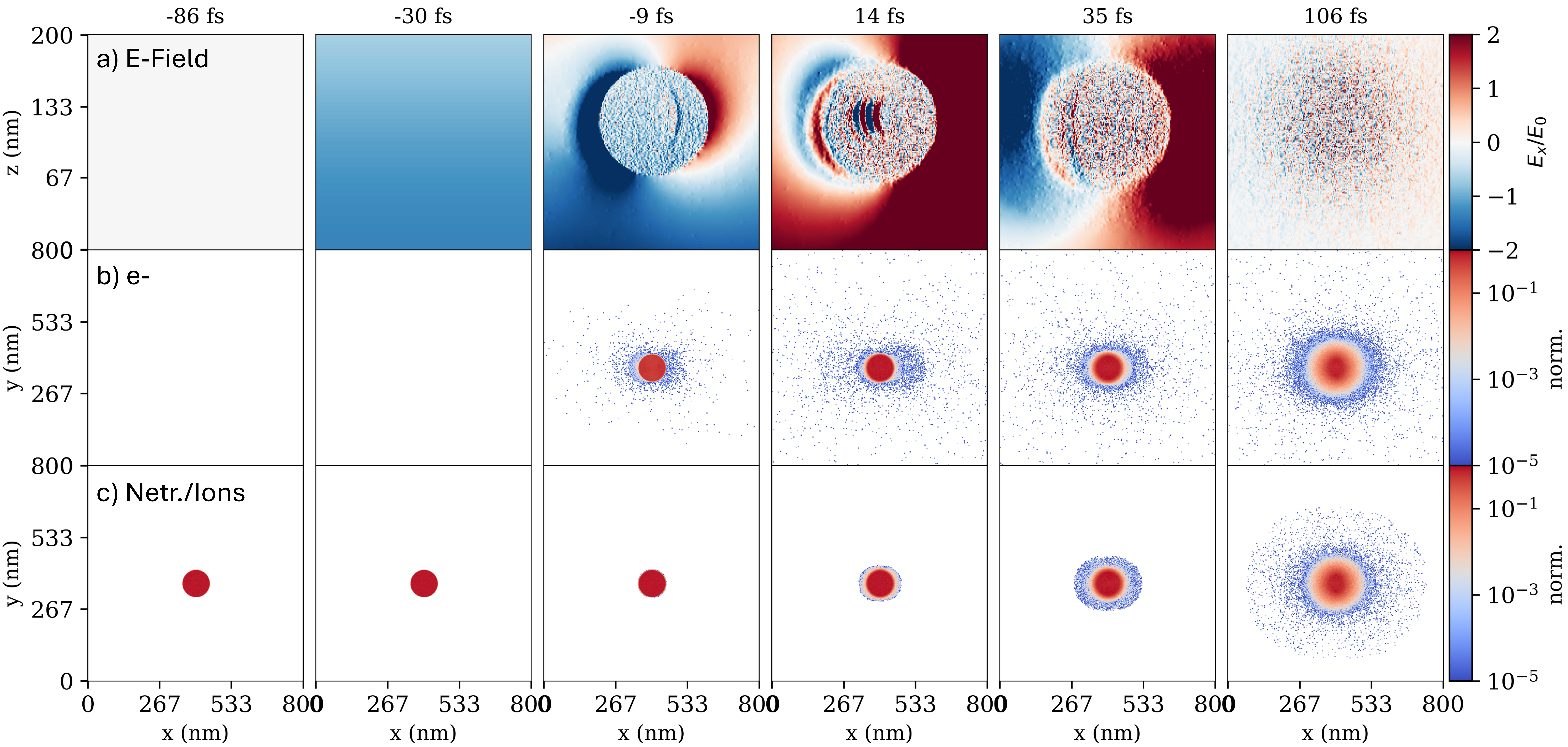
Fig. 1. Spatio-temporal evolution of a laser-driven helium nanoplasma for the initially neutral target. a) normalized laser field component Ex/E0 in the polarization direction plane (polarization along x, propagation along z). b): electron distribution and c) helium core-particle distribution (all charge states, Z = 0, 1, 2). Times are given relative to the laser peak at the target (t = 0)
Helium nanodroplets provide a unique and versatile platform for investigating strong-field-driven nanoplasma dynamics [1]. In this work, we present large-scale, GPU-accelerated particle-in-cell simulations using PIConGPU [2] to study the interaction of pure helium nanodroplets containing up to 106 atoms with intense near-infrared femtosecond laser pulses, and we compare the results with single-shot velocity-map electron imaging and ion measurements. The simulations describe the plasma evolution from the first ionization events to collective electron motion, nanoplasma formation, and early expansion. We show that the calculated electron and ion observables reproduce the main features of the measured spectra in systems with similar cluster sizes and laser intensities. Our results demonstrate that PIConGPU captures the essential physics of nanoplasma formation previously addressed mainly with molecular-dynamics or TDDFT approaches [3], while remaining computationally efficient and applicable to much larger systems. This establishes PIConGPU as a powerful and scalable tool for connecting nanoplasma theory with experimentally accessible observables.
References
- A Mikaberidze, U Saalmann and J M Rost, Phys. Rev. Lett. 102, 128102 (2009)
- https://github.com/ComputationalRadiationPhysics/picongpu, 2026. [Online; latest release picongpu-0.8.0 at 18-December-2024]
- C Peltz, C Varin, T Brabec and T Fennel, New J. Phys. 14, 065011 (2012)