

Acousto-Optic Couplers in Biconical Fused Optical Fibers for Tunable Devices and Laser Cavities
Invited Talk
Y Navarro-Martínez1, E Hernández-Escobar1, M Bello-Jiménez Dr.1, R López-Estopier1,2, M V Hernández-Arriaga3, J Flores-González1, M V Andrés Dr.4
1 Instituto de Investigacion en Comunicacion Optica, Universidad Autónoma de San Luis Potosí, San Luis Potosí, Mexico
2 Secretaría de Ciencia, Humanidades, Tecnología e Innovación (SECIHTI), México City, Mexico
3 Instituto Tecnológico Superior de Rioverde, Tecnológico Nacional de México, San Luis Potosí, Mexico
4 Universitat de València, Valencia, Spain
Seminar: S8 — Fiber Optics
Wednesday, 8 July 2026 · 16:15 – 16:45
Abstract
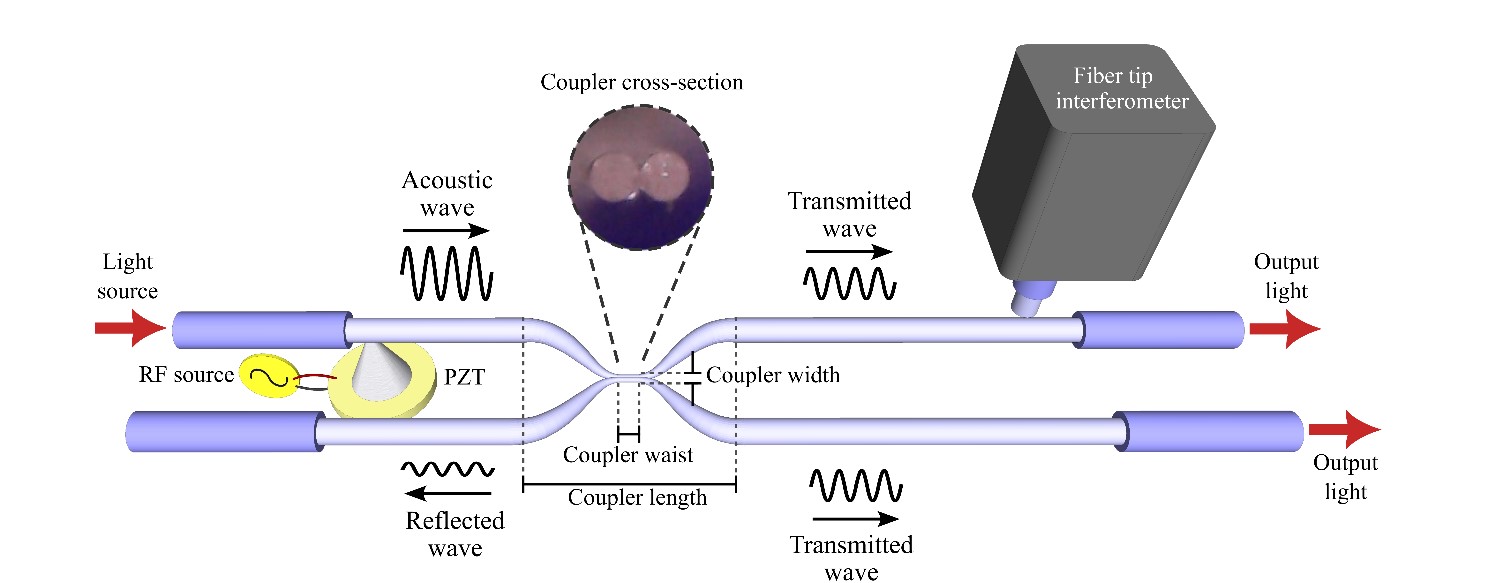
Fig. 1. Experimental setup of the acousto-optic coupler
Acousto-optic interaction in optical fibers provide a versatile mechanism for controlling guided light through acoustic waves. In particular, traveling flexural acoustic waves induce periodic perturbations along the fiber, enabling resonant intermodal coupling between the fundamental core mode and a higher-order modes. This effect has been widely exploited in all-fiber devices such as tunable filters, modulators, mode converters, sensors, and active components for laser cavities. In this context, the development of components capable of simultaneously manipulating optical and acoustic fields enables advances in fiber-optic technologies.
In this work, we report the experimental development of 2x2 acoustic and acousto-optic fiber couplers fabricated by a standard fusion-and-pulling technique, see Fig. 1. The devices are obtained by thermally fusing two parallel single-mode optical fibers as stretching the resulting structure to form a fused biconical taper. Initially, devices with negligible optical coupling are investigated as purely acoustic couplers for travelling flexural acoustic waves. The acoustic wave is generated by a radiofrequency driven piezoelectric disk and induced into the fiber using an aluminum horn; its amplitude at the input, reflected and transmitted ports is characterized using an extrinsic fiber-tip interferometer. By controlling the tapering parameters, such as the coupler width and length, different acoustic coupling ratios are obtained, ranging from 73:27 to 36:64, with excess losses between 3 and 6 dB and low values for the return loss.
A second configuration is investigated to demonstrate simultaneous acoustic and optical coupling. In this case, traveling flexural acoustic waves around the 2‒MHz region are used to induce resonant intermodal acousto-optic interaction near the 1550‒nm spectral region in standard single-mode fiber (SMF-28). The device exhibits nearly balanced dual-field operation, with coupling ratios close to 44:56 for the optical field and 47:53 for the acoustic field, demonstrating the potential of fused biconical fiber couplers as multifunctional all-fiber devices. Finally, the integration of these acousto-optic couplers into fiber laser cavitie is briefly discussed. A ring fiber laser cavity incorporating the developed coupler has been implemented, resulting in high-order laser emission. Since the cavity operation relies on the acousto-optic interaction enabled by the coupler, the laser can operate in both continuous-wave and pulsed regimes, highlighting the relevance of these devices for active acousto-optic systems and dynamically controlled fiber laser cavities.