

Dark Solitons in a Bubble Bose-Einstein Condensate
Invited Talk
R W Sallatti1, L Tomio2, D Pelinovsky3, A Gammal1
1 Institute of Physics, Universidade de São Paulo, São Paulo, Brazil
2 Institute of Theoretical Physics, Universidade Estadual Paulista, São Paulo, Brazil
3 McMaster University, Hamilton, Canada
Seminar: S6 — Physics of Cold Trapped Atoms and Ions
Friday, 10 July 2026 · 14:20 – 14:45
Abstract
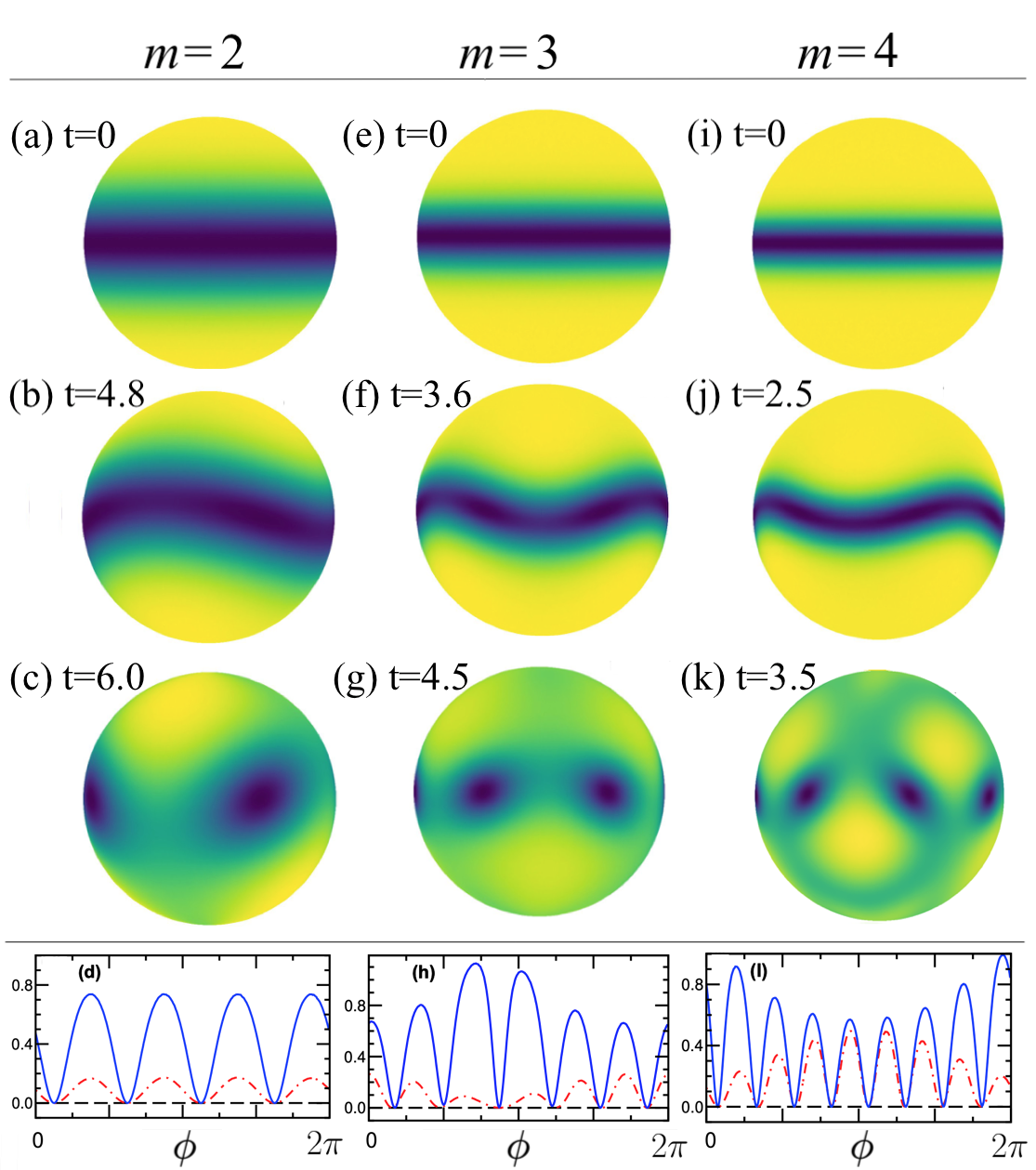
Fig. 1. Dark-soliton dynamics, for given instants $t$, with dominant instability modes $m=2$ (left panels, $\varepsilon=20$), $m=3$ (center panels, $\varepsilon=50$), and $m=4$ (right panels, $\varepsilon=100$), shown by the densities $|\psi|^2$. In 3D graphics, the darker the region, the less dense it is. At the equator, with $t$ corresponding to the upper panels in the same column, $|\psi(\frac{\pi}{2},\phi)|^2$ are shown in (d), (h), and (l). The bottom dashed lines are for $t=0$; the red dotted-dashed, when snake instabilities occur; and the solid-blue lines, after the breakup in vortex pairs.
Nonlinear waves on curved surfaces is a problem of widespread interest across physics. Here, we establish the stability criteria for dark solitons on a spherical Bose-Einstein condensate. We demonstrate a sharp instability threshold in the nonlinear parameter, beyond which solitons decay into vortex dipoles via snake instabilities. Analytically and numerically, we prove this decay is dictated by a single unstable mode for each angular momentum $m \geq 2$, which is a universal mechanism that controls the resulting vortex state. Unlike in the full three-dimensional case, where snake instabilities lead to vortex rings, a dark soliton confined to the surface of a bubble can only decay into vortex pairs.
References
- Phys. Rev. A 113, L041303 (2026)